|
Join Bart and Curt in a lively
discussion with their seminar audience:

TRANSCRIPTION of 8 minute audio:
Bart: What I want to do is, go to section 8 and run through some of these other traits we didn’t cover.
Remember when we talked about self-consciousness? Second "m" hump higher than the first "m" hump? Opposite of that in handwriting is diplomacy, but it isn’t really opposite in psychology. It doesn’t make a lot of sense that it’s opposite.

But, you will find people with humps that go downhill tend to be much more kind with words, and say things in a way that’s much more eloquent, and it’s a positive trait.

So, when you’re deprogramming self-consciousness, you’re actually programming what? Got a problem with that? Sounds like a good trait to me – it’s a good trade-off.
Curt: Oh, well it had a very negative influence on my life after I changed it – I was very, very sarcastic, and I took out self-consciousness and put in diplomacy, and now I’m so nice, I’m not very sarcastic any longer.
Bart: he passed that to his kids, so we can make up for it.
Conscious – fear of ridicule. Self-consciousness is fear of what?
Audience: ridicule
Bart: Right – which is interesting, because sensitivity to criticism is different than self-consciousness, but it may appear the same.
So, if someone is self-conscious, how would they respond if you criticize their clothes? If they’re self-conscious, they’re afraid of what you might say to them, rejection. They may not be sensitive to you actually criticizing them.
So, one is present tense, the loop in the d is your present tense, "I’m reacting to criticism." Self-conscious is afraid of something happening in the future.
Curt: Our mothers teach us, "Wear clean underpants, what happens if you have a wreck, what will people think?" And our teachers did this, you see? When they tell you,
"Alright, Curt, you never know, you never keep up." I’m on page 7, the kids are reading page 2, then she tells me I never keep up – I didn’t know. So, I developed a fear of ridicule, because that’s what they’re doing – they’re ridiculing to try to get us to do what they want us to do.
Bart: So, sometimes it’s the fear of what will happen in the future, versus sensitivity to criticism and what’s happening now, but people will perceive it the same way.
Clothes you wear, will you stand up in class, will you ask a pretty girl out, will you ask a guy to dance – those are very similar. One is a fear of rejection, one is a fear of criticism, but they seem very similar at times.
Curt: They both hurt, don’t they?
Bart: Yes, that’s true.
Desire for Culture – another sign of intelligence or edumacation. People say, "Bart, why don’t you have an accent?" "Because I’ve been edumacated. I grew up in Texas, but I decided that I
did not want to talk like Ross Perot, so I’ve been edumacated."

The Greek E, or the d that sort of falls back. You have to be careful, because if the d is really loop, or squared on top, it’s sort of a paranoia, but this is really elegant. You’ll see that if there’s a desire for culture, there’s a lot about their handwriting that’s sexy. It sort of has an elegance to it, or Greeky, or
something like that.
Yes, Jennifer?
Jennifer: What about the past?
Bart: Something in the past is "e." That’s the tricky part about that. If it’s going too far in the past, then it becomes guilt. If it’s just sort of like a sexy, swoopy d, it’s desire for culture.
Jennifer: Could making a sexy, swoopy d and having a desire for culture actually cause a problem in the past, if you were to add that into your handwriting?
Bart: Yes, I would never add that into my handwriting. It’s sort of like, you kind of know it when you see it, the desire for culture stuff…
Curt: I hate to tell you Jennifer, you either have culture or you don’t. (audience laughs)
Jennifer: Hey, I’ve got the "E." I might not have the "d," but I do the "E" naturally.
Bart: Upper loops – we talked about this, this is the demonstration part of the exercise. Big loops on the k’s and h’s indicate a large…religions, philosophy, yeah.

By the way, they’re philosophical, they’re very spiritual, and they will hate the fact you called them religious. You know, fanatics. But, they do think about the future a lot, they think about what’s after we die, they think about the things that are in the ancient scrolls, they will be interested in what’s outside of today. It’s not all clothes, make-up and, you know, music or whatever.
Now, would you like a preacher with big loops or no loops on their h’s?
Jennifer would like to comment – you said "big loops," on his h’s – what does that mean?
Jennifer: Well, to me, that would signify somebody that’s more open, they’re not as close-minded.
Bart: And you would like that because…?
Jennifer: I would like that because of, I guess, my own beliefs about spirits.
Bart: What if, like, he sat in a room with a Buddhist, and the next time you went to church, he’s decided he’s got to meditate instead of what he did last week, because he was so open?
Jennifer: (pause) What do you mean? (audience laughs)
Bart: OK, what if you are a Christian, and you have a preacher with very open loops on the top. He visits with a Buddhist for awhile, and he goes, "You know what? This is cool! I’m going to teach my congregation how to meditate and reach the seventh chakra." And you come in, and you’re all
excited, because you want a Baptist preacher to tell you about hellfire and damnation, and how bad you were Saturday night, and you get a meditation lesson. Wouldn’t that make you upset?
Jennifer: I can’t relate. (audience laughs)
Bart: To which part?
Jennifer: I would be open to it, so I wouldn’t be able to relate to the whole, damnation and brimstone, but I understand what you’re saying, though.
Curt: That’s a good answer, then, you wanted your preacher to have open h’s.
Unknown student: Well, it seems if you were in one particular religion, you would want them to be closed up, because that would simply signify that they are set in their ideals, they’re set
in their religion, they’re set in what they believe, and if you’re following that particular religion, you would want them to have them closed.

Bart: That’s a nice, logical argument, isn’t it?
Curt: If there’s a locked-down code of ethics, you’re not interested in what anybody else says, whatever you’ve got your going to keep. Opposed to, you didn’t buy into everything they tried to teach you in Sunday School class, you’re still looking for some answers, some proof, some
truths that you would buy into. Isn’t that a good way to say it?
Bart: By the way, that question is actually on your test. And I have both answers, and I would give you both A’s. Seriously, because you could explain it in the way that it made sense to you.
What religion are you, may I ask? Catholic – are you still Catholic? Sort of? Do you feel guilty just, like, waking up?
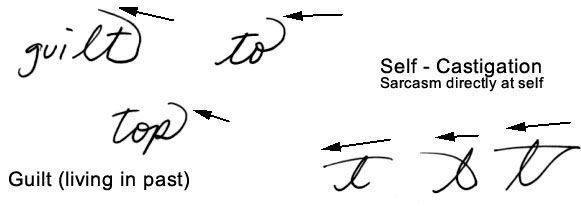
Student: What’s so interesting is, when you had first helped me with some of my traits, you know, the self-castigation, some of those things, and it was really cool, because you had mentioned
before, "Are you Catholic by any chance?"
And that just floored me, I was like, how the hell did you figure that out? You know? And…
Bart: Hell?
Student: How the hell, yeah (audience laughs). And so the really cool thing about that was that you said to me, really, basically, knowing your last name, Ortega, I figured you weren’t Jewish, so the Jewish and the Catholic religions are so good at putting guilt into you for things you never did.
And that is so perfect and so true, because it does. You know they teach you that whole guilt thing and so you find all kinds of guilt patterns.
I worked at a Catholic University for about a year, and oh my gosh, the strokes that were in the handwriting of the people that had been there, it was like, "Give it up, folks."
Curt: The worst emotion ever invented by man to control other people…
Bart: Well, the best use of control, I mean it works real well – the Catholic church is the biggest landholder in the world. If you want some cash and money, guilt is good.
And the best thing about that is, you promise them, like, something after they’re dead…you know, I’ve got to give you like a seminar to get your money, right? If I was really smart, I’d make myself a god, and promise all these parties when your dead. Dang, that’s brilliant, I should have thought of that – I’m going to rule the world one day.
Go ahead.
Student Question: The t’s that are connected up there to the h’s and stuff, is that what you’re talking about, the shallow people?
Bart: Um, yeah, there’s a little shallow thinking in there. Again, you guys kind of made me say that trait – I don’t use that trait very much, it’s not something I see a lot of and…
Student: Well how would you read it?
Bart: Well, judging by the big, fluffy bimbo writing, I would have to agree with you.
Student: If it wasn’t fluffy bimbo, the way the t is…
Curt: Whoa, whoa, wait, wait – it doesn’t come back up, it’s just an incomplete saucer. It wouldn’t be shallow thinking, because it’s all going to drain out. What’s it doing? It’s going down, and then into the religious aspect, and this particular person has religious guilt, so what are they going to do? Control your thinking to be like theirs?
Bart: And they have big y’s, too, so they’re also very gullible in a lot of areas. But, no, it’s not the most analytical writing you could see. And shallow thinking means, "I’ll take the facts," you know, but also the m’s are very round, so there’s not a lot of analytical ability. If there’s no analytical ability, they’re also going to be kind of shallow.
Student: Bart? The first teacher I had in graphology years ago, she would describe those as a person who kind of believed in things, like your mom may have told you about prince charming
and stuff – which goes along with the shallow thinking, and that’s how I think I would interpret it, when I see that.
Bart: Your mom told you about me? (audience laughs)
Student: No, it’s just illusions. And it’s funny, because it…
Bart: You’re right, it is! (audience laughs)
Student: ..the shape of it is a symbol of the planet Neptune, which rules illusions.
Bart: Really? What does Uranus rule? (audience laughs) It’s the planet next to Neptune, isn’t it?
Student: Electricity. (says more, but unintelligible)
Bart: You really answered that question, didn’t you?
Curt: The very large top, what does it do? It inflates, so you have an imagination in the…?
Bart: Religious, philosophical areas. Especially if it’s flat-topped, like a balloon hitting the ceiling? That’s when you really get guilt.
I don’t see it a lot. (unintelligible student comment) I agree…
Curt: This is not big enough to be magnificent in that area, but I just wanted you to understand it’s the beginning…
Bart: But, it is kind of flat on top. It looks like a balloon that hit the ceiling, a little flat? That’s where you get the guilt, and the paranoid in the d’s – it has a little bit of that flatness on there. So, it’s a good observation. A little bit, but…
Ann, I think you had a comment?
Ann: You would think someone that has culture would have a little bit more intelligence.
Bart: Where is the culture?
Ann: With the "E’s."
Bart: Culture? I mean, you’ve got the desire for culture, but truly just a lack of analytical abilities. The lack of someone with a lot of upper zones – not much upper zones, not very analytical, just not real bright. Not the brightest bulb.
Yes ma’am?
Student Question: What about when there’s just a downstroke for the h? Just only a downstroke?
Bart: That’s a good question – someone else asked that same question about her d. It’s a downstroke with no upper loop…
Curt: Which means? What does a downstroke in the t mean? No fluff, I don’t want to know anything I don’t need, let’s get to it. So, you don’t know what their religious orientation is, and they’re not interested in telling you.
Student: But it’s not a locked-in philosophy…
Curt: You don’t know what it is, see, because they don’t display it. It’s in print, isn’t it? Downstroke, they don’t display what they really think.
Bart: And without the upper part of the stroke, you can’t get the unconscious. See, we’ve just got a
downstroke, so we just don’t know the answer. You have to have a full loop to know if it’s repressed or not.
Curt: What you tell people is, "I don’t know what kind of code of ethics or religion you have, but
whatever you’ve got, you’re not interested in sharing it with me." Now that covers it, see, the just don’t tell you. They know you know, but they don’t know what you don’t know. And you don’t know what you don’t know.
Bart: Let’s talk about religion more, this is fun.
Is there anybody we didn’t make mad? There’s Buddhist’s, we’ve got the Catholics, we’ve got the Baptists, I mean, I’m sure there’s someone we missed, but remind me…
Oh, the Mormon’s!
Curt: Well, they go in the lower loop area.
Bart: That whole multiple-wife thing is sooo 1800’s. They don’t do that anymore.
OK, we’re going to take a five minute break, we’re going to come back and talk about a little more guilt…
End recording.
======================================================
If you would like to share this newsletter with a friend, you can
also visit the above link and click on the subscribe button.
myhandwriting.com/newsletters/subscribe.html
|

